Every Tool in Your Stack Grades Its Own Work
Your ad platforms, your sequencer and your CRM each report on how well they performed. Attriqs is the scoreboard underneath all of them, and it is not one of the players.
Where Go-to-Market Measurement Breaks
Not because anyone is careless. Because the data crosses a boundary and nothing carries it across.
Every platform marks its own homework
An ad platform reporting on the performance of its own ads has an obvious interest in the answer. Add two or three of them together and the conversions they each claim will exceed the sales you actually made.
The source dies at the handoff
A lead arrives with a source attached. It becomes an opportunity in another system, and the source does not come with it. By the time it closes, the deal has no memory of what created it.
The phone is invisible
Plenty of go-to-market motions end in a conversation, not a form. If calls are not tied back to the campaign and the search that produced them, every channel that drives calls looks like it does nothing.
Nobody agrees which number is real
Marketing reports one figure, sales reports another, and finance reports a third. The meeting is spent reconciling numbers rather than deciding anything with them.
What It Answers, and What It Does Not
A go-to-market plan turns on a handful of decisions. Attriqs speaks to some of them directly and has nothing useful to say about others.
Who is actually worth targeting
Lifetime value and cohort analysis by the channel that first brought a customer in. The segment that converts most cheaply and the segment that stays longest are often not the same one.
LTV and cohort analysisWhich route deserves the budget
Marketing mix modeling estimates what each channel contributes from spend and revenue over time, with no individual click required, and shows where returns start to flatten as spend rises.
Marketing mix modelingWhether the motion produced revenue
Multi-touch attribution run against revenue rather than platform-reported conversions, so the answer does not depend on which platform you ask.
Multi-touch attributionWhat happened on the phone
Call tracking with dynamic number insertion ties a phone enquiry back to the ad, campaign and search that produced it, alongside forms and chat.
Call trackingWhere the deal actually went
Attribution and CRM on one record rather than two systems with a handoff between them, so a closed deal still knows what created it months later.
Attriqs CRMWhat it will not tell you
Nothing about what to charge. Pricing and packaging are a judgement about your market and your margins, and no measurement tool has an opinion worth having on them.
It Sits Under Your Stack, Not In Place of It
Attriqs does not find contacts, enrich them, or send sequences. Whatever you already use for that keeps doing it. What those tools cannot do is tell you, independently, whether the motion produced revenue, because each of them is reporting on its own contribution.
That is the job Attriqs does. It measures outcomes against revenue across every channel at once, including the ones that end in a phone call, so the answer does not change depending on which dashboard you open.
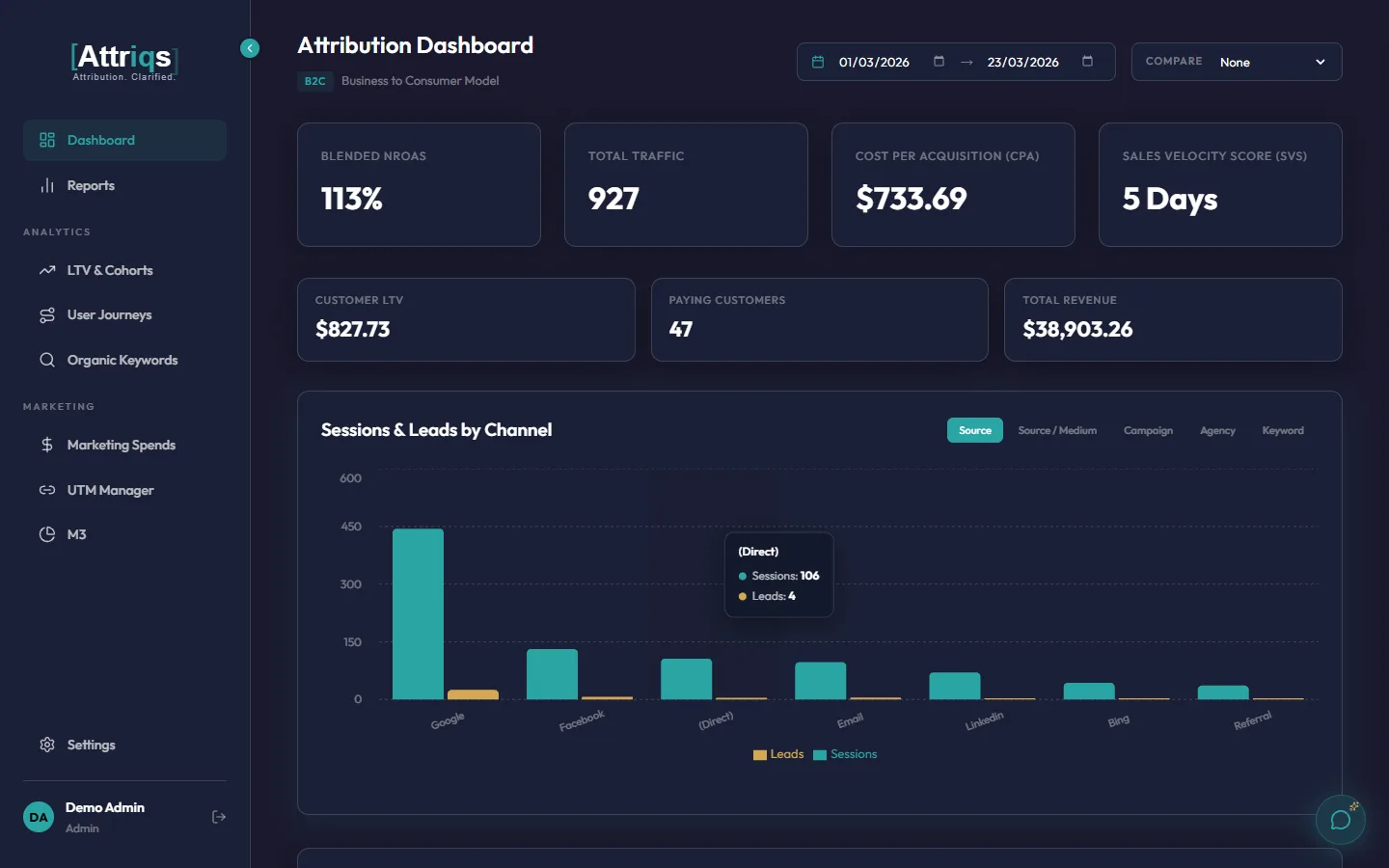
Wire the Scoreboard Before the Launch, Not After
Measurement is usually retrofitted. The motion launches, the numbers get argued about for a year, and by the time anyone can say whether it worked, the budget for the next one is already committed.
It is far cheaper to decide what counts before you spend than to reconstruct it afterwards from three systems that disagree. Agree which outcomes matter, make sure they are being recorded against their source, and set what a good first quarter looks like while you can still change the plan.
If you are weighing up measurement tools for a motion you are about to run, our five questions to ask before buying attribution software is the list we wish every buyer brought to a demo, including ours. If the harder question is which route to take in the first place, EncubIQ, the consultancy behind Attriqs, does go-to-market strategy work for small and mid-sized businesses.
See Whether the Motion Actually Produced Revenue
Book a 20-minute walkthrough and we will show you how Attriqs connects campaigns, calls and deals to the revenue they produced.